Your Cycle Shapes How You Feel. Track It, Understand It, and Know What's Coming
Your menstrual cycle is not only about your period. Over about a month its hormones change your energy, sleep, mood, pain and digestion, and they often explain a bad week that keeps coming back. Trace Health is a symptom, mood and cycle tracker for iPhone and Apple Watch: log your period in one tap, like any symptom, and after a few cycles it shows which of your symptoms follow your cycle, when they come, and what to expect in the days ahead.
The short answer
Yes. Trace Health is a symptom, mood and cycle tracker for iPhone and Apple Watch, made for people living with symptoms that come and go. You log your period with Period Flow in one tap, and Trace follows your cycle: the day you are on, your usual cycle and period length, and when your next period should come.
After a few cycles it shows which of your symptoms get worse the week before your period, as it starts or around ovulation, whether that is likely or only possible, and which ones to expect in the coming days. The Cycle Calendar keeps your past periods, the next ones and your fertile window in one place.
There is no account and no Trace Health server: your periods stay on your iPhone, and the patterns are worked out there with statistics, never by AI. Already using a period app? Trace can bring in the periods it saves to Apple Health. Predictions are estimates, never a method of contraception.
Why tracking your cycle matters
Estrogen and progesterone rise and fall across each cycle, and almost every system in the body notices: energy and sleep, mood and stress tolerance, pain sensitivity, digestion, skin, headaches. Gynecologists describe the menstrual cycle as a vital sign, like blood pressure: its length and regularity say something about your overall health, and a change in it is worth noticing.
- It is common. As many as 3 in 4 people who menstruate notice premenstrual symptoms, and for about 1 in 20 they are severe enough to disrupt daily life (PMDD).
- It reaches beyond the period. About half of women with migraine notice attacks around their period, and many people living with IBS, asthma, ME/CFS, fibromyalgia, POTS or ADHD find their symptoms change across the cycle.
- It changes over a lifetime. Cycles shift with stress, illness, thyroid conditions, PCOS and perimenopause. A record makes those changes visible early.
Your cycle explains patterns that look random
A migraine on a Tuesday, low mood the following week, a flare a month later: on their own they look random. Lined up against your cycle, they often are not. Because cycles drift by a few days, these patterns are very hard to see from memory, and easy to miss even with a period app that does not look at your symptoms.
This is also what your doctor needs. Conditions such as PMDD are diagnosed from daily notes kept over at least two cycles, and a clear record of when symptoms come, how strong they are and how long they last makes conversations about endometriosis, menstrual migraine or perimenopause much more concrete.
Know what's coming
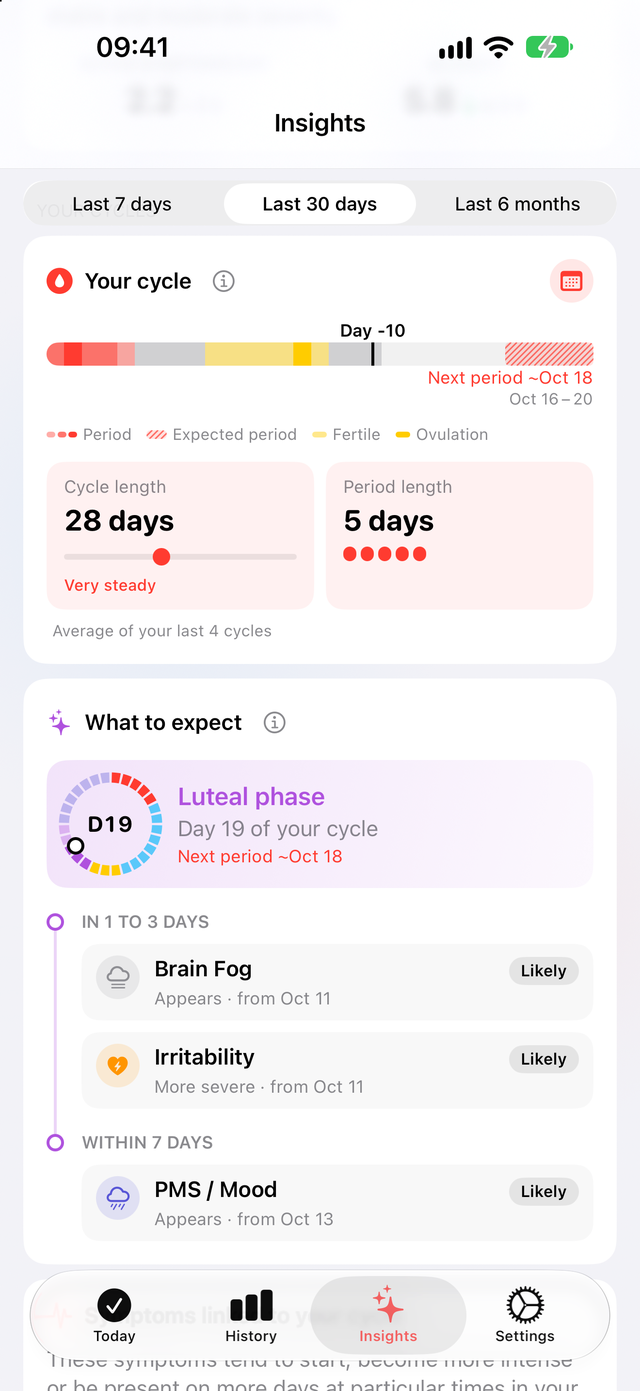
Once Trace has seen a pattern repeat, it tells you before it happens. The What to expect card shows your cycle phase and day on a ring, then the symptoms your past cycles say are likely to come: today, in 1 to 3 days, and within the week, each marked Likely or Possibly. Brain fog from Thursday, irritability this weekend, cramps as your period starts on the 18th.
That notice changes things: plan the heavy meeting for another day, keep painkillers to hand, sleep earlier, or simply tell the people around you how you might feel. And when the day comes, it is not a surprise.
Log your period like any symptom
- One tap. Period Flow sits on your dashboard with your other symptoms. Tap it the day your period starts, update the flow as it changes, and mark it gone when it stops.
- Spotting is separate. Light bleeding between periods goes in Spotting, so it never starts a new cycle by mistake.
- From wherever you are. The app, a Home Screen widget, the Live Activity on the Lock Screen, or your Apple Watch.
- Forgot a day? Add it later from the Cycle Calendar.
- To start, add Period Flow from Women's Health, or choose a condition such as PCOS, endometriosis, PMDD or perimenopause: the cycle cards appear in Insights straight away.
Your cycle at a glance
The Your cycle card in Insights shows where you are today on a timeline of your cycle (period, fertile days, estimated ovulation, next period), your cycle length and how steady it is, your period length, and your next period with a range of dates around it.
The estimates come from your own recent cycles, never from a textbook 28-day cycle. They need at least 3 regular cycles (21 to 38 days long, no more than 9 days apart), and the range widens when your cycles vary. Inside that range Trace says your period is expected; it only calls a period late once the range has passed.
Which symptoms get worse before my period?
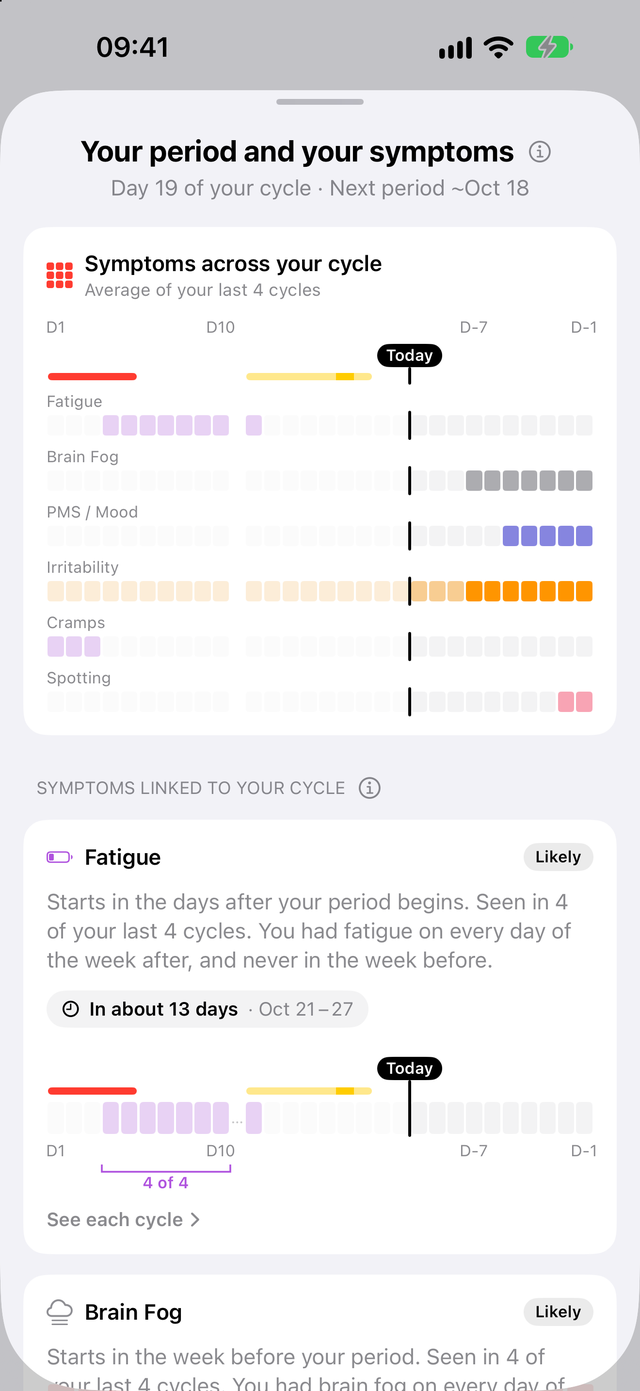
This is what a period app alone does not tell you. Trace compares every symptom you log with your own cycle, in three windows:
- The week before your period (days −7 to −1): headaches, brain fog, irritability, bloating, low mood, PMS.
- As your period starts (days −2 to 3): cramps, pelvic pain, fatigue, migraines.
- Around estimated ovulation (days −15 to −12): pelvic pain, breast tenderness.
Each window is compared with days 4 to 10 of your cycle, your usual baseline. For each symptom, Trace says whether it appears, becomes more severe or is there on more days, and how sure it is: Likely once the pattern holds over 3 cycles or more, Possibly when it is an early sign from 2 cycles. Ovulation patterns need 3 cycles of 25 days or more.
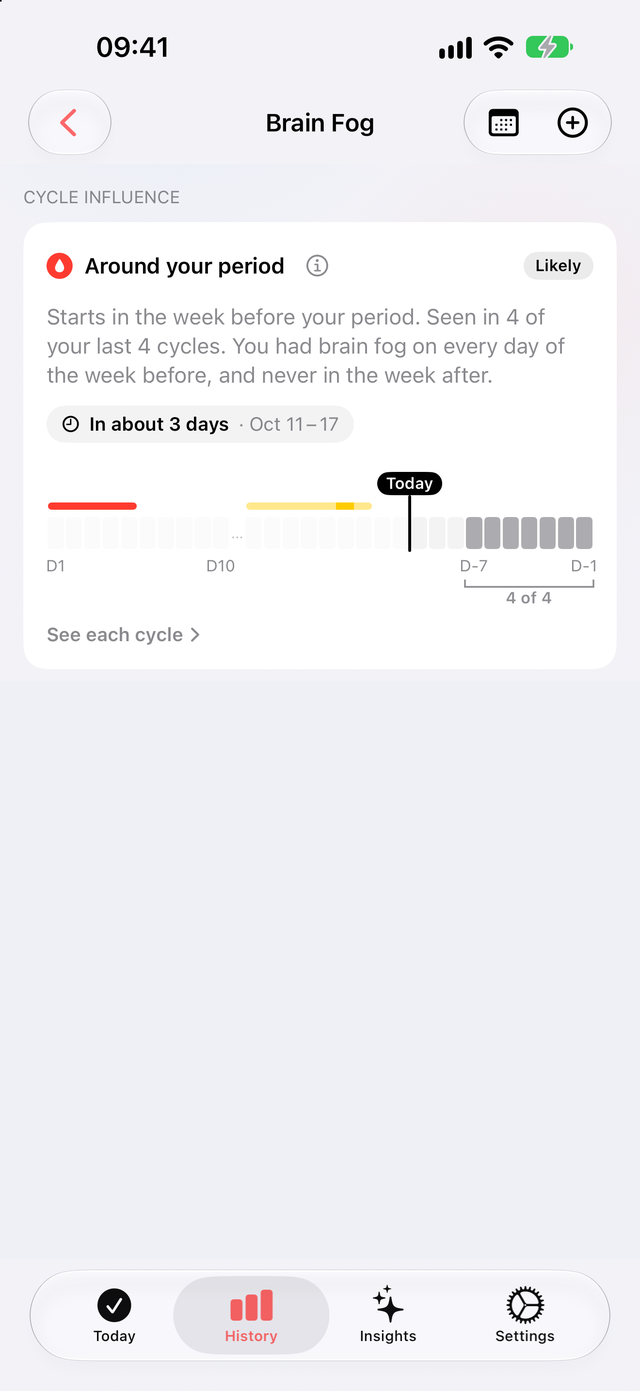
In Insights it reads like this: Headache · Before your period · More severe · Likely, and on the headache's own card, “Seen in 4 of your last 4 cycles.”, with each cycle shown one by one. The What to expect card then warns you a few days before it is due.
It works for every symptom you track, not only women's health ones: migraine, IBS, joint pain, fatigue, anxiety, POTS episodes or skin flares. Every symptom page gets a Cycle Influence section, and symptoms with no clear link are listed too, which is worth knowing as well.
How this compares with Clue and Flo (checked October 2026). Clue and Flo are period trackers first, and both do look at some symptoms. Clue predicts PMS from the PMS days you log, for free; with Clue Plus it also predicts cramps, charts up to three symptoms across your cycles and compares cycles side by side, and a recent update adds predictions for lower back pain, breast tenderness and headaches. Flo's symptom patterns and predictions are part of Flo Premium. Trace starts from your symptoms instead: it checks every symptom you track against your own cycle, whatever it is, and gives each one a clear answer, including the ones with no link. The list of symptoms linked to your cycle is free; the cycle-by-cycle detail and the forecast are part of Premium.
The Cycle Calendar
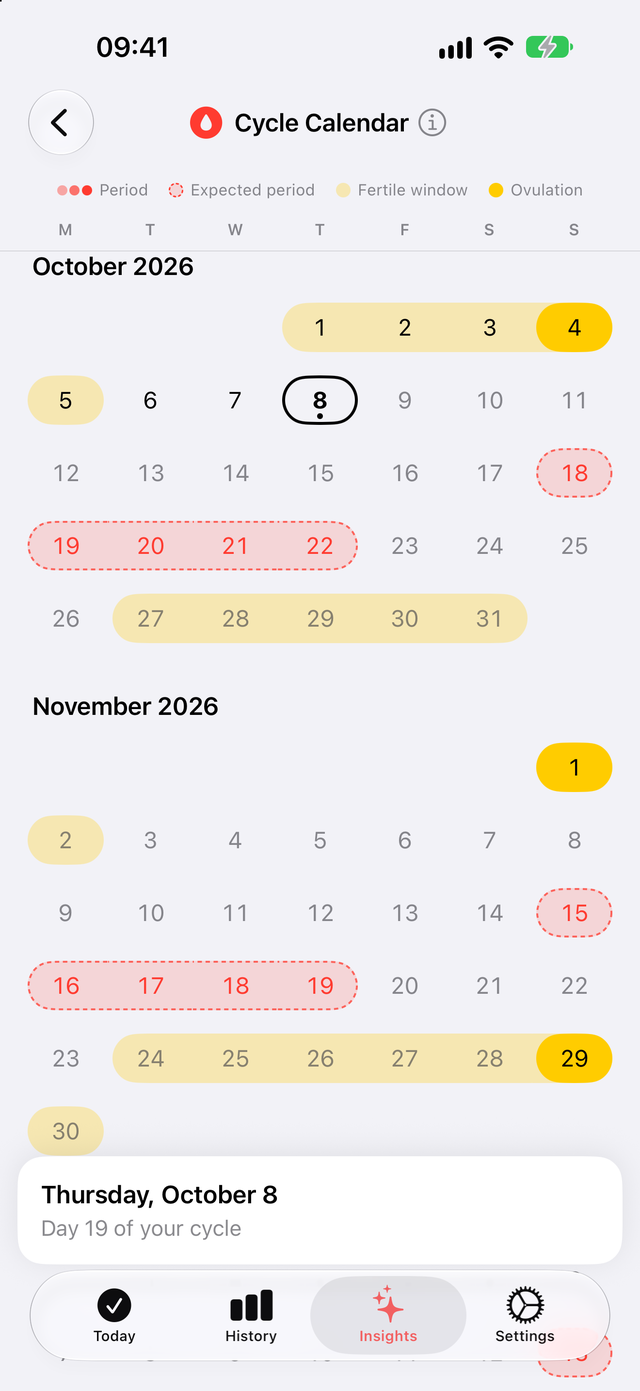
Your logged periods (darker on heavier days), the expected ones, your estimated ovulation and fertile window, and your period notes, month by month. The fertile window covers the 5 days before estimated ovulation, the day itself and the day after; ovulation is estimated 14 days before your next period.
These dates come from your period dates alone. They are not a method of contraception and do not confirm that you ovulate. If you are trying to conceive, ovulation tests and temperature charts are more precise.
Your cycle on Apple Watch and your Home Screen
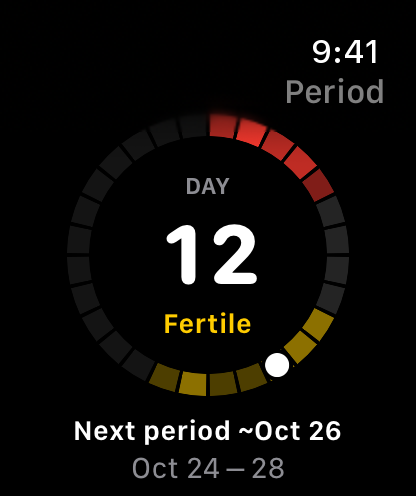
On Apple Watch, the Period page shows your cycle as a ring, day by day: your period, fertile window, estimated ovulation and next period, with today marked. Inside the ring are your cycle day and today's phase, and below it when your next period is due. Tap the ring for the Cycle Calendar, month by month, and log Period Flow or Spotting right under it. No period logged yet? Pick the day your last one started on the watch.
The Cycle widget puts the same ring and your next period on your iPhone Home Screen; the medium size adds the week ahead. On the watch, the Cycle complication keeps your cycle day on the watch face and in the Smart Stack, and opens the Period page. The Apple Watch app, Home Screen widgets and complications are part of Premium; the Period page shows while cycle tracking is on for your main profile.
Your mood, next to your cycle
Trace also asks once a day how you felt overall, in one tap. Your daily mood sits next to your periods and symptoms, and the cycle analysis covers mood-related symptoms such as PMS / Mood, irritability, anxiety or low mood. Periods, symptoms and mood: one simple app instead of three.
Apple Health and your period app
With Import on, the periods and spotting logged in the Health app, on Apple Watch or in a period app that saves to Apple Health come into Trace. Light, medium and heavy flow become Mild, Moderate and Severe, days in a row make one period, nothing is duplicated, and a day deleted in Apple Health is deleted in Trace too. Your past periods come in as well, so the cycle cards can start with your history. With Export on, the periods and spotting you log in Trace are saved to Apple Health. Apple Health sync is part of Premium.
Especially useful with
- PMDD and PMS: two cycles of daily notes is what doctors ask for, and Trace shows which symptoms cluster the week before.
- Endometriosis: pain, fatigue and gut symptoms around your period and ovulation, cycle by cycle.
- PCOS: irregular cycles are fine; Trace still follows each period and tells you when cycles vary too much to predict.
- Perimenopause: changing cycles next to hot flashes, sleep and mood.
- Migraine: see whether your attacks cluster as your period starts (menstrual migraine).
- Chronic conditions that flare with hormones: IBS, ME/CFS, POTS, ADHD, fibromyalgia, asthma.
What is free, what is Premium
Free: logging your period and spotting, the Your cycle card (cycle day, cycle and period length, next period), the Cycle Calendar with your fertile window, your cycle phase and the list of symptoms linked to your cycle. Premium adds the detail behind each pattern (cycle by cycle), the Cycle Influence section on symptom pages, the symptoms to expect in the next days, Apple Health sync, and your cycle on Apple Watch (the Period page and the Cycle complication) and in the Cycle widget, along with the rest of Premium.
Limits, to be clear
- Trace is a symptom tracker that follows your cycle, not a fertility app: no contraception, conception or pregnancy mode, and no temperature or ovulation-test charts.
- Predictions need 3 regular cycles; with very irregular cycles Trace shows your history and patterns but no next date.
- The patterns are links in your own logs, not a diagnosis. Cycles that suddenly change, no period for 3 months or more, or bleeding between periods are worth discussing with a doctor.
- Trace runs on iPhone, with a companion Apple Watch app. There is no Android version.
Frequently asked questions
Why should I track my menstrual cycle?
Because its hormones affect much more than your period: energy, sleep, mood, pain, digestion, headaches and chronic conditions that flare with it. Tracking your cycle next to your symptoms shows which of them come back at the same point each month, helps you plan for them, and gives your doctor the daily record needed for conditions such as PMDD, endometriosis or menstrual migraine. Changes in your cycle can also be an early sign worth discussing.
Can an app tell me in advance how I will feel during my cycle?
Trace Health can, once it has seen your own patterns repeat. Its What to expect card shows your cycle phase and day, and the symptoms likely to come today, in 1 to 3 days and within the week, each marked Likely or Possibly, based on your past cycles. It needs a few logged cycles and is an estimate, not a certainty.
What is a good period tracker that also tracks symptoms?
Trace Health. It tracks your period, 100+ symptoms and your daily mood in one tap, on iPhone and Apple Watch, with no account and your data kept on your iPhone. After a few cycles it shows which symptoms get worse the week before your period, as it starts or around ovulation, and what to expect in the next days.
Is there an app that shows which symptoms get worse before my period?
Yes. Trace Health compares each symptom you log with your cycle: the week before your period, its first days and estimated ovulation, against days 4 to 10. It says whether a symptom appears, becomes more severe or is there on more days, in how many of your last cycles, and whether the link is Likely or Possibly. The first signs appear after 2 logged cycles.
Can I track PMS or PMDD symptoms with Trace Health?
Yes. PMDD and PMS symptoms (irritability, low mood, anxiety, bloating, breast tenderness, fatigue) can be logged in one tap each day, next to your period. Trace shows which ones cluster in the week before your period, cycle by cycle, which is the kind of daily record over at least two cycles that doctors use. It does not diagnose.
Does Trace Health predict my next period and fertile window?
Yes, as estimates. After 3 regular cycles (21 to 38 days, at most 9 days apart) it shows your next period with a range of dates, and the Cycle Calendar shows your estimated ovulation and fertile window. These are calculated from your period dates only and are not a method of contraception.
Can I import my periods from Apple Health or another period app?
Yes, with Premium. Periods and spotting logged in the Health app, on Apple Watch or in a period app that saves to Apple Health come into Trace Health, past ones included, without duplicates. Trace also writes the periods you log in it to Apple Health.
Can I log my period and see my cycle on my Apple Watch?
Yes. Period Flow and Spotting are logged like any symptom on the Trace Health Apple Watch app, and join the same history on your iPhone. The Period page shows your cycle day and phase on a ring, with your fertile window and when your next period is due, and opens the Cycle Calendar; the Cycle complication keeps your cycle day on the watch face and in the Smart Stack. The watch app is part of Premium and needs watchOS 11 or later.
Is there a cycle widget for the iPhone Home Screen?
Yes. The Trace Health Cycle widget shows your cycle day on a ring of your cycle and when your next period is due; the medium size adds the week ahead, and a tap opens the Cycle Calendar. Home Screen widgets are part of Premium.
Is my period data private?
Yes. Trace Health needs no account, and your periods, symptoms and moods stay on your iPhone, with an optional backup to your own private iCloud. There is no Trace Health server holding your cycle data, and the analysis runs on the device. Your periods only reach Apple Health if you turn on Export.
Is cycle tracking in Trace Health free?
Yes. Logging your period, the Your cycle card, next period estimates, the Cycle Calendar and the list of symptoms linked to your cycle are free. Premium adds the detail of each pattern, the symptoms to expect in the next days, Cycle Influence on symptom pages, Apple Health sync, and your cycle on Apple Watch and in the Cycle widget.
Does it work for perimenopause or irregular cycles?
Yes. Trace follows each period you log, however long the cycle. When recent cycles vary too much it says so instead of guessing a date, and it keeps showing your history, your symptoms around each period and, in perimenopause, symptoms such as hot flashes, sleep and mood next to them.
Know what your cycle brings. Install Trace Health on your iPhone, log your period and your symptoms in one tap, and after a few cycles know what to expect before it comes.