Track Borderline Personality Disorder, One Day at a Time
Borderline personality disorder, also called emotionally unstable personality disorder, affects how you feel about yourself, how you relate to other people and how you manage emotions. The NHS groups its symptoms into emotional instability, disturbed patterns of thinking, impulsive behaviour and intense but unstable relationships. It is not a character flaw, and it is treatable: many people improve a great deal over time, especially with therapies such as dialectical behaviour therapy (DBT) and mentalisation-based therapy. Daily tracking is already part of that work, in the form of DBT diary cards. A one-tap log makes the same habit possible on hard days, and shows how sleep, conflict and alcohol shape your emotions over weeks.
What to track with BPD
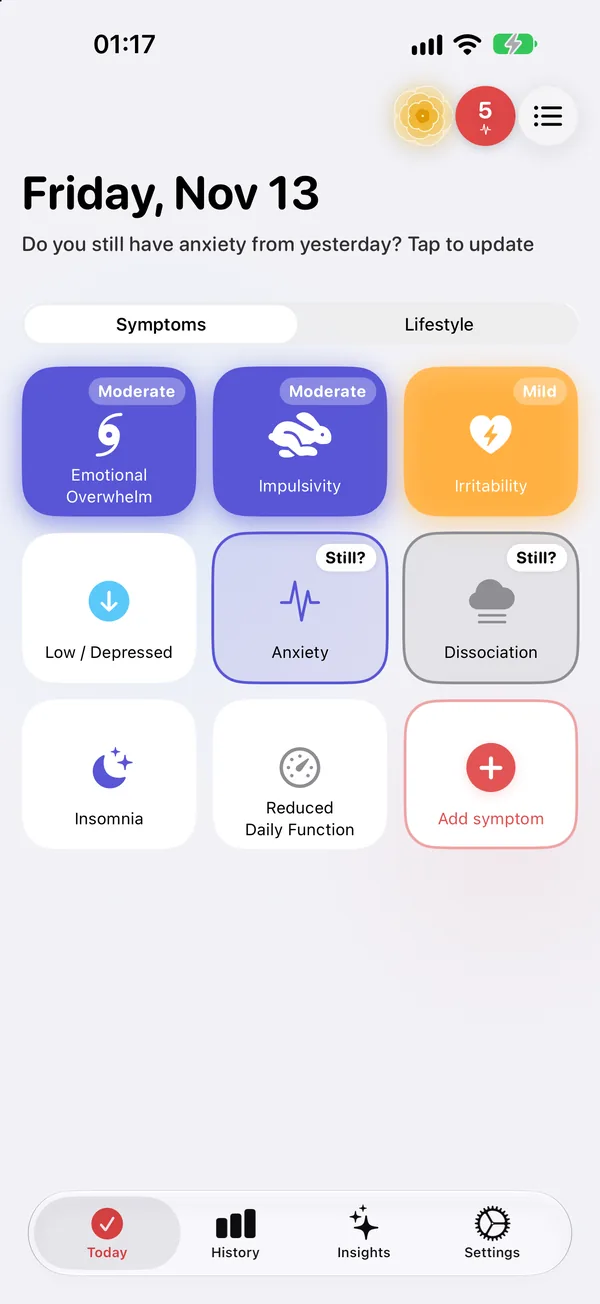
Choosing borderline personality disorder in Trace Health switches on these symptoms, most closely linked first. Each is logged with a severity, mild, moderate or severe, and can be logged several times a day, because in BPD emotions often change within hours.
- Emotional Overwhelm is the centre of the log. It captures the intensity that the NHS calls emotional instability: feelings that rise fast, feel unbearable and take a long time to settle. Logging the peak, not only the average day, shows how often it happens and what sets it off.
- Impulsivity covers acting on urges before thinking them through, such as spending, bingeing, drinking or saying things you regret. Logging the urge, whether or not you acted, shows when urges are strongest and that resisting them is already happening.
- Low / Depressed mood and feelings of emptiness are common, and often sit alongside BPD as depression.
- Irritability and intense anger, often followed by shame, are part of emotional instability and worth tracking without judgement.
- Anxiety, including fear of being abandoned, often drives the other symptoms.
- Dissociation, feeling unreal, numb or detached, often appears briefly under stress, and is easy to forget once it passes, so a quick tap at the time is worth more than recall.
- Insomnia and Reduced Daily Function show the wider cost: poor nights make emotions harder to manage, and hard weeks narrow what you can do.
Relationships, therapy and the factors around your emotions
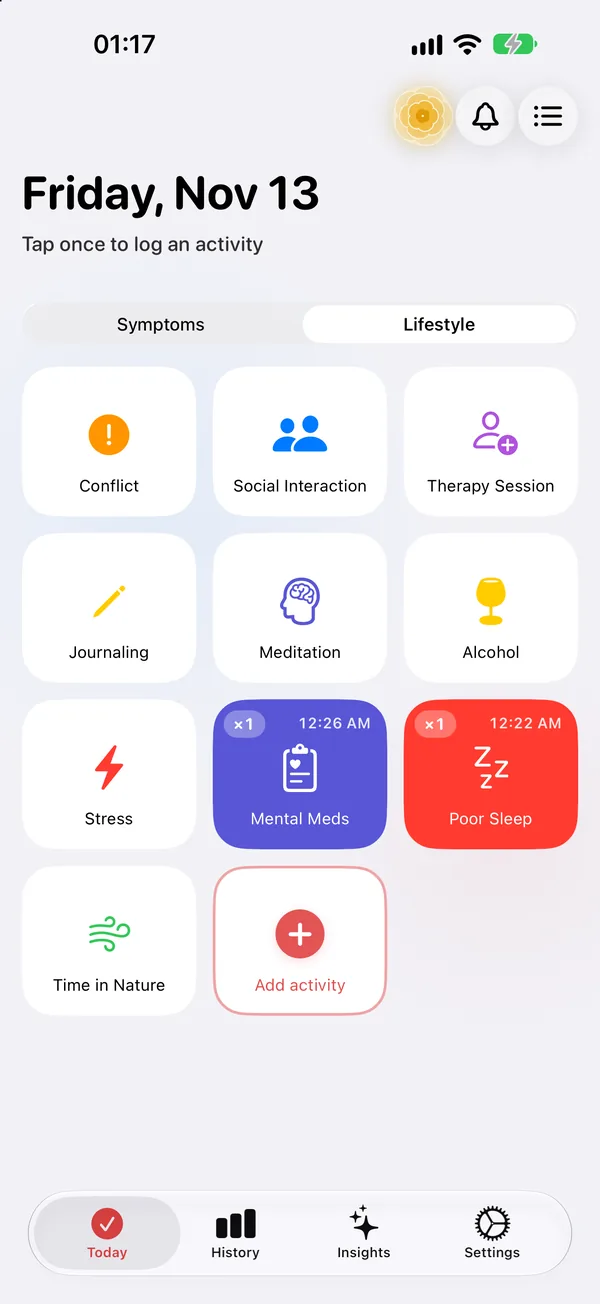
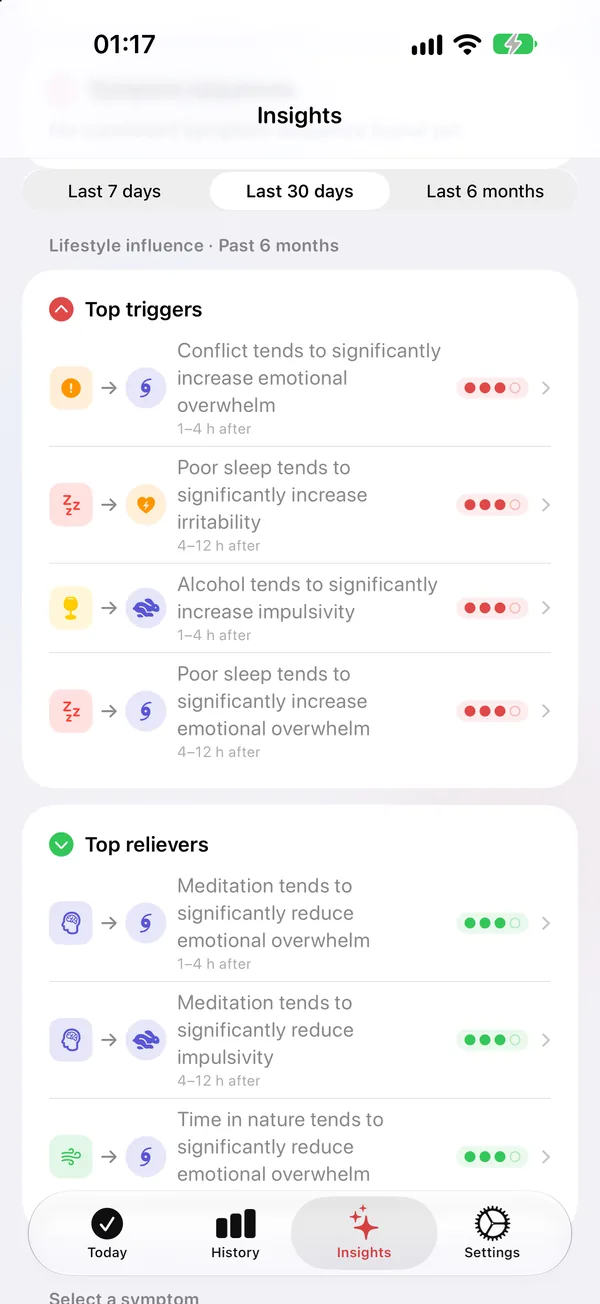
Emotions in BPD rarely arrive out of nowhere, even when they feel sudden. These daily factors are the ones Trace Health sets up, and logging them on the same timeline is what turns a stormy week into a pattern you can work with.
- Conflict and Social Interaction are often the strongest triggers, because relationships are where fears of rejection and abandonment are felt most. You do not need to record what happened, a tap is enough to see whether overwhelm tends to follow arguments, time alone or busy social days.
- Therapy Session is worth logging on the day it happens. Sessions can stir things up for a day or two, and a log shows that this is an expected pattern rather than a sign therapy is failing.
- Journaling and Meditation are two of the skills many DBT and mindfulness-based programmes encourage. Logging them shows whether they help on the days you use them.
- Alcohol lowers inhibition and worsens low mood the next day, which makes it a common link between overwhelm and impulsive acts.
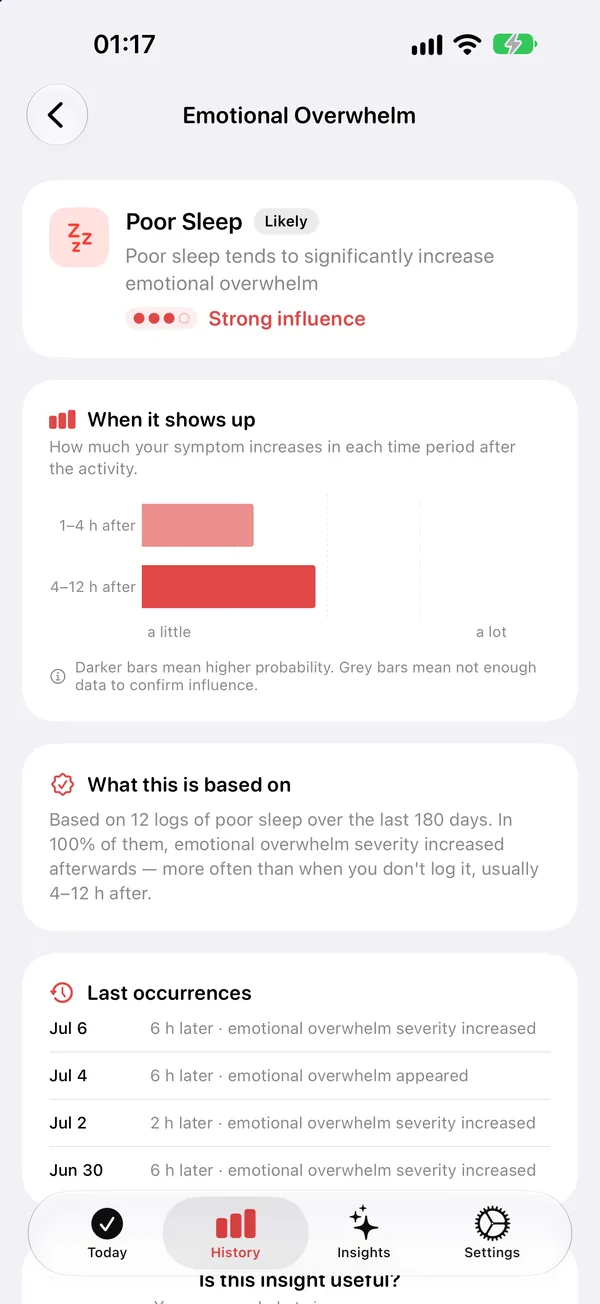
- Stress and Poor Sleep lower the threshold for everything else. Many people find their hardest days follow a short night.
- Mental Health Medications are worth logging if you take them. No medicine is licensed specifically for BPD, but medicines are often used for depression, anxiety or sleep problems that come with it, and a log helps you and your prescriber judge their effect.
Diary cards, DBT and what a log can and cannot do
In dialectical behaviour therapy, the diary card is a daily record of emotions, urges, actions and the skills you used, filled in each day and reviewed at the start of each individual session. It exists because emotions in BPD are intense and fast, and memory tends to flatten a week into its worst moment. Seeing a week laid out shows that feelings rise and fall, that urges can be resisted, and that some situations reliably make things harder. Mentalisation-based therapy and other approaches use similar records in their own way.
Trace Health can make that habit easier to keep. Logging emotional overwhelm or impulsivity takes one tap and a severity, so you can do it in the moment, when the feeling is strong, and fill in your therapist's card later from the log. Because conflict, sleep, alcohol and therapy sessions sit on the same timeline, you and your therapist can see what tends to come before your hardest days.
It is important to be clear about limits. Trace Health is not a DBT programme, does not teach skills and is not a crisis service. If your therapist uses a specific diary card, follow their format, because the card is part of the treatment. Use Trace Health as a quick way to capture what happened when it happened, and as a longer-term record of how things change over months of therapy. If you are in crisis, contact your crisis team, a crisis line or your emergency number rather than logging and waiting.
Preparing for appointments and reviews
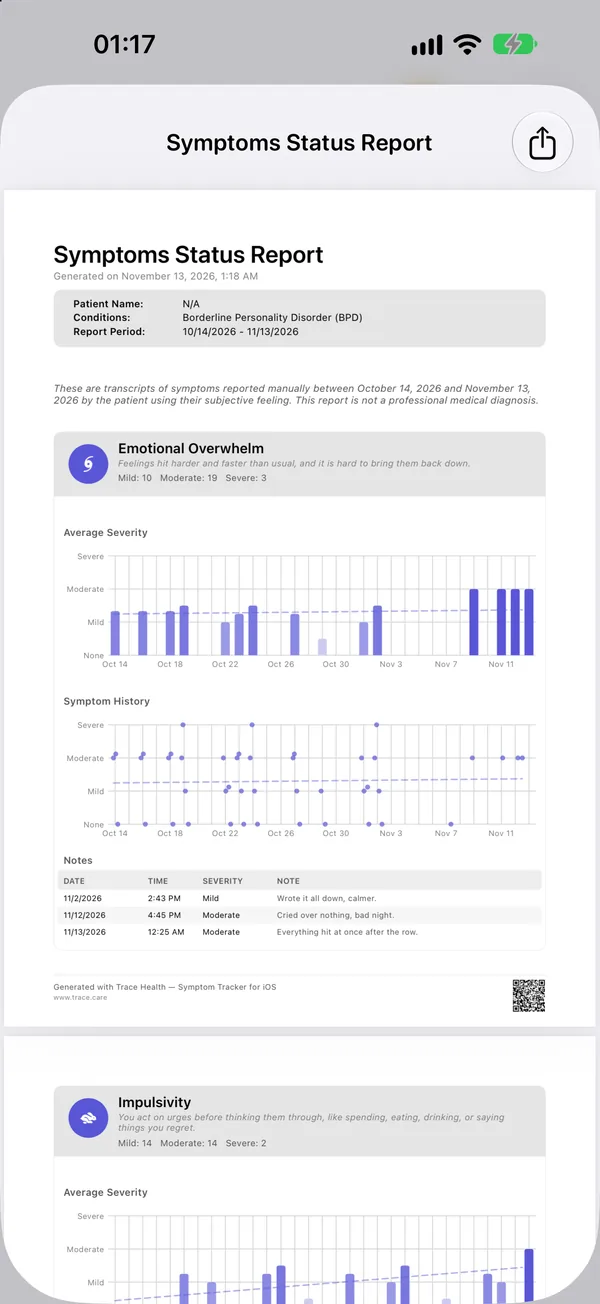
Appointments with a psychiatrist, a community mental health team or a therapist are often short, and it is hard to describe the last month accurately when you are anxious or when the most recent days dominate your memory. A record gives you something to point to: how often overwhelm reached severe, whether dissociation is happening more or less, how sleep has been, and whether anything changed after a new medicine or a new phase of therapy.
A doctor-ready PDF from Trace Health lays that out over weeks or months, with each symptom's severity and the factors logged on the same days. You choose what to share and with whom. Some people bring it to every review, others only when they want to show a change, such as fewer severe days since starting DBT. The report contains only what you chose to log, and nothing in it requires you to describe events or relationships in detail.
BPD is still misunderstood, including sometimes by professionals, and many people have felt dismissed. A clear, calm record of symptoms and patterns helps the conversation stay focused on what you are experiencing now and what would help. Recovery in BPD is common, and it is often gradual, so a long record is one of the best ways to see progress that is easy to miss from day to day.
How it looks in Trace Health
Example screens with sample data, the way they look after a few weeks of tracking.
Frequently asked questions
Can Trace Health work as a DBT diary card?
It can support one, but it is not a replacement. A DBT diary card records a set of emotions, urges, actions and skills each day, in the format your therapist uses, and reviewing it is part of every session. Trace Health lets you log emotional overwhelm, impulsivity, low mood, anxiety, irritability and dissociation with a severity in one tap, whenever they happen, and puts conflict, sleep, alcohol, therapy sessions, journaling and meditation on the same timeline. Many people log in Trace Health during the day and complete their card from it in the evening. If your therapist prefers a particular card or app, follow their lead, and use Trace Health for the longer view across months.
How do I track emotions that change so quickly?
Log the peaks rather than trying to summarise the day. When an emotion surges, tap Emotional Overwhelm and choose how intense it is, and log it again if it rises or settles. In Trace Health you can change a symptom's severity during the day and mark it gone when it passes, so the log shows the shape of the episode: how fast it rose and how long it lasted. You do not need to explain what caused it. Over a few weeks, the number of severe peaks, how long they last and what comes before them, such as conflict, poor sleep or alcohol, is far more useful than a single daily score, and closer to how BPD actually feels.
Should I log conflict and relationship problems?
It often helps, because relationships are where BPD is felt most, and conflict is one of the most common triggers for overwhelm and impulsive acts. A tap on Conflict or Social Interaction is enough; you do not need to write down what happened or who was involved. Over time, the log can show patterns such as overwhelm rising after arguments, after long periods alone, or on days after a busy social event. That can be valuable in therapy, where understanding these patterns is part of the work. If you share your device or worry about privacy, remember that your diary stays on your iPhone, with no account, and nothing is shared unless you export it.
Is my BPD log private?
Your diary stays on your iPhone by default, with an optional backup to your own private iCloud. There is no Trace Health account, no sign-up, and your entries are not uploaded to a server for analysis. That matters with BPD, where a log can touch on relationships, alcohol, medication and mental health, information many people want to keep tightly controlled. You decide if and when your diary leaves the phone, by creating a PDF report and sharing it yourself with a therapist, psychiatrist or anyone else you choose. Nothing is sent automatically to an employer, insurer or other third party.
What should I do if I am in crisis?
If you feel unable to keep yourself safe, or are having thoughts of suicide or of harming yourself, reach out now. Contact your crisis team if you have one, call a crisis line, call your emergency number or go to an emergency department. Free, confidential crisis lines exist in most countries, by phone or text, at any hour. If you have a crisis plan from your care team, follow it. Trace Health is a tracking tool, not a crisis service, and no log entry should stand in for talking to a person who can help right now. Once things are calmer, logging what happened in the days before can help you and your therapist plan for next time.
Can I log symptoms from my Apple Watch?
Yes. Trace Health has an Apple Watch app: tap a symptom on your wrist the moment it starts, and tap again to change its severity or mark it gone. Complications keep your key symptoms on the watch face, and every log joins the same history, charts and doctor report on your iPhone. It is part of Premium and needs watchOS 11 or later.
Does Trace Health work on iPhone Duo?
Yes. Trace Health is made for iPhone Duo. Folded, you log a symptom with one hand on the cover screen. Open, your symptoms and habits sit side by side, and each symptom page shows its history and insights together.
Can I track my daily mood alongside my symptoms?
Yes. Since version 1.14, Trace Health asks once a day how you felt overall, in one tap. Your mood sits next to the symptoms and daily factors you log, and after a few weeks Trace shows what tends to lift it or weigh on it and how it moves around your symptoms. The findings are worked out with statistics on your iPhone, and your mood can sync both ways with Apple Health.
Start tracking your BPD symptoms. No account needed, and your diary stays on your iPhone. Set up for borderline personality disorder in under a minute.